Face First Media | Outdoor Billboard Advertising South Africa

Future DOOH Trends
to Hit the Right Targets

Even though DOOH (Digital Out of Home) advertising has been around for some time, it took some effort to hone in on the most effective ways to employ it. What has become noticeably clear, is that DOOH is here to stay, and it just gets more sophisticated as time goes on and new technologies develop. A report by UpBeat has recently confirmed that the DOOH market will take a large chunk from advertising budgets, hitting around $8,3bn (just in the USA) by 2023. As a result, new trends are introduced all the time by innovative tech companies, and these innovations help advertisers not only stream relevant content to their potential clients but also to gather information from them.

Here are some of the new trends emerging on the DOOH market that helps users to make their advertising strategies a lot more effective:

  • Omnichannel: Mobile advertising is having a huge impact on users, but this technology has now been extended to billboards. Online advertising via mobile phones, computers, email and social media can seamlessly be integrated for optimum results! It is also possible to combine several campaigns on the same platforms – which provides much better ROI.
  • Dynamic creation: When it comes to other digital marketing strategies, DOOH still falls behind on the engagement ratio. This is because a lot of brands are still choosing to use OOH with static images instead of progressing to DOOH which can be integrated with other platforms. Relevant DOOH can increase awareness of a brand by 18%, according to Virtuo City in the UK. Severe creativity is needed to enhance these campaigns, and here are some ideas about how to do this, using new trends in DOOH.
  • Geo-targeting: Locating relevant messaging via DOOH can draw people to local events and outlets. For instance, where there are a lot of truck drives passing, put a billboard pointing them to a restaurant or truck stop nearby. During evening hours in the city, use DOOH to draw people to your pub and advertise your happy hour! You can even use this example to direct students outside of a university or college to drive them to a retail store or shopping mall.
  • Weather: What? Weather? Yes, weather! DOOH can be used to measure temperature and direct accordingly. For instance, on an ice-cold day, users can be directed to the nearest store selling heaters, warm clothing or electric blankets. On a hot day, they can be directed towards the nearest ice cream store! Weather plays a big part in behaviour, so why not use this to your advantage.
  • Commuters: While billboards have been pointing towards commuters for decades, it is now possible to create a more captive audience. City people spend a lot of hours per year commuting – via it is by train, underground or vehicle. Ads can now be generated to respond to specific traffic conditions by providing geo-targeted options for commuters.

As marketers, it is continuously crucial to come up with new, creative and innovative strategies to reach audiences. DOOH is still one of the most cost-effective ways to do this, and its popularity is only increasing. Call our team at Face First Media to find out more about this.

Marketers struggle at the best of times to fit their campaigns into their advertising budgets. Recently, online advertising has become the norm, but it is not as effective as one may think! It can be frustrating. Ad blockers are all the rage, and even though a lot of money is spent on creating very creative online campaigns, online ad blockers prevent a large portion of users to view the ad. The others very seldom view the ad, choosing to skip over it to reach the web content they are looking for. Even if the advertisement is viewed, there are so many now, that the ad must stand out above a multitude of others to draw attention.

These problems do not affect Out of Home advertising. Outdoor advertising usually consists of billboards (static or digital), and they are virtually

Billboard Advertising

unmissable, especially when they are placed in the correct demographic areas. They are unblockable, highly visible, and attract attention. OOH is the perfect medium to send out large messages to those who matter most to your brand.

With new technology, digital components can be introduced to capture specific markets at specific times, but this does not take away from the ubiquitous presence of the static billboard. Studies performed by Ocean NeuroScience confirmed that OOH is much more likely to drive around 48% of consumers to a particular website or venue after being exposed to OOH advertising (as opposed to online advertising). In addition to this, studies performed by Nielsen and the OAAA in the USA shows that 46% of their test groups had been motivated to explore an online site after being exposed to an OOH advert. This means that even though OOH is one of the most ancient forms of advertising, that it is still very much a contender when it comes to advertising spend and effect.

Why Is OOH Suddenly Popular Again?

One of the main drivers that empower outdoor advertisers, is the introduction of digital technology. Billboards no longer have to be static. They can be programmed to display particular ads at specific times of day, depending on the audience. For instance, having a billboard in a commuter drive can entice them to purchase breakfast at a local outlet, but once schools finish for the day, the same board can be used to drive traffic to the local clothing outlets, skateparks, or malls that cater for students.

Not only is this more effective at reaching correct target markets, but a billboard can be shared by various brands, which means lower costs for the marketer. With this comes the security that the target market is being exposed to the ads at the correct time of day when they are most likely to invest in the brand. Digital technology also introduces creativity, brighter colours, movement that attracts the eye, and entertaining content.

Television and print media is static and limited, and display only to an audience that watches television or reads magazines!

Call our team at Face First Media to find out more about how we can help you to optimise your advertising budget!

With the advent of Digital Out of Home advertising, the usual static Out of Home advertising seems that have taken a little bit of a knock in the industry. OOH advertising is usually a billboard that does not include movement, other than to display an image. DOOH involves digitization that can be managed from a central point to display different electronic images and messages at different times of day, so it is generally more flexible when it comes to hitting different markets during certain times of the day.

The question remains, however, is there now space for OOH in a world that is becoming increasingly focused on DOOH? Well, the short answer is yes! This is for various reasons:

  • OOH is cheaper: Obtaining digital technologies require a significant outlay from the advertisers, and as a result, these expenses are brought over to the client. Static billboards are already in place, and they are cheaper and easier to manage.
  • No sharing: Because OOH displays a static image, there is no need to share your billboard advertising with other advertisers. This means that your billboard image remains in the same place and visible at all hours of the day until the term is up, and that you can ensure that your target market experiences only your advertising every time they drive past the billboard.
  • Effective reach: Because static billboards remain the same, they capture attention for longer, and are visible repeatedly to a well-honed target market. This means that the messages come through stronger and are retained longer.
  • Impact power: External billboards have a space in peoples’ lives and are often referred to as landmarks. Digital advertisement can also be irritating, and as a result, many people use advertising blockers on their phones and computers. Having a static billboard is not affected by this and can convey a message constantly.
  • Efficiency: Billboards are great for the distribution of information to certain segments. Caution must be exercised here though to ensure that the best locations and advertisements are chosen for maximum impact.

While DOOH also offers many benefits, there is clearly still space for static billboards in the OOH market, and when honed properly, can yield great results! So, whether you are interested in OOH or DOOH, our team at Face First Media are always at your disposal to help put together a highly subjective campaign that will hit your target markets in the correct positions and provide great results. Contact us today to find out more!

Outdoor advertising may be seen by some as a separate world from digital advertising, but this is not the case as it has become a social channel.

Digital advertising has grown exponentially over the last decade causing a shift in attention and budget allocation from outdoor advertising. It however soon became clear that consumers’ attention isn’t focused on one form of advertising.

Marketing Is Entering A New Era

Social media has taken advertising by storm and everybody wants a piece of the cake.

Advertising has evolved so much over the past decades and the Internet opened new frontiers for advertising.

Social media ensures that people spend a huge amount of their time online. Advertising on social media also has its challenges. This includes:

  • Facebook algorithm changes
  • Rising ad costs
  • Getting noticed in overcrowded feeds
  • Too many trends to keep up with
  • Authentic connection with the audience
  • A dramatic drop in organic reach
  • Tracking results

Marketers get unique insights on how to reach consumers if they know where consumers are going, what they pay attention to, what they need, and where they shop.

Using Outdoor Advertising as A Social Channel

Billboards have become more eye-catching seeing that people spend so much time in front of screens and have become pros in ignoring or blocking pop-up ads and banners. Outdoor advertising can, however, be greatly amplified when consumers share ads on social media.

A photo of an eye-catching billboard on social media can travel the globe in an instant. Marketers are in the position to effectively create advertising campaigns that complement themselves across different platforms.

If an advertisement is creative and eye-catching enough consumers will amplify the product or service on behalf of advertisers. Research has shown that consumers are posting photos of interesting outdoor advertisements on social media platforms such as Instagram which leads to a specific advertisement being seen by three times as many people.

With social media in the mix outdoor advertising has become more about creating a culture and less about creating ads. Another study has shown that consumers are more likely to buy, engage with a brand on social media or download an app after seeing an outdoor advertisement.

Seeing that the use of social media occurs primarily on mobile devices consumers always have their devices on the ready when they are out and about. This means that campaigns that can integrate both can influence the impact of both mediums.

Much has been written about DOOH and OOH lately. The question is often what the distinctive differences between the two are, and which of these to choose for your outdoor advertising campaign. Firstly, before DOOH, we had OOH. OOH stands for Out of Home advertising. This includes mostly static billboards that are stationed in areas and locations where they can draw the most attention to the people who matter. The images are usually printed and displayed on huge billboards and remain there until the advertising campaign or contract is over. OOH is largely focused on capturing the attention of people who traverse the same route on roads, walking in the same areas and locations where a particular business is operating. OOH billboards, however, cannot be updated or changed as often as DOOH, because it requires a large format print, and someone to practically set up the billboard with a new visual image.

DOOH indicates a shift to Digitised Out of Home advertising, and new technology has brought along a whole new era of outdoor advertising for commercial purposes. These “billboards” display electronic images that can move (much like television or online advertising), and it is possible to interact with users on digital platforms. Advertisers can also share these boards, which means that messages on DOOH can be displayed at different times by different advertisers to hone in on their target markets. For instance, in the morning commute, messages can be displayed that advertise products to high-income commuters, while during mid-morning other advertising media can be displayed that may appeal to homemakers and stay at home parents. During lunchtimes, advertising for restaurants and special food promotions can be displayed. This flexibility in advertising allows the same board, on the same location, to capture different markets at different times of the day.

OOH remains relevant and is overall cheaper than DOOH. It also delivers a constant message over time which increases retention and consumer loyalty. DOOH is more expensive but can be highly versatile, as it can be combined with various online platforms during a single advertising campaign. They can also be interactive and prompt people to respond online to a question, breaking news, a booking, or a promotion, or even to leave feedback on the advertisement displayed.

DOOH advertising, as a result, can provide feedback on the target market and the types of users it attracts through its campaigns. It is dynamic and flexible, and interesting to watch. Often cameras or CCTV are also built into these dynamic billboards to measure consumer behaviour and to gauge audience numbers. It can therefore provide a more accurate reflection on the ultimate success of the campaign and user numbers.

If you are keen to find out which advertising media would be best suited to your campaign or company, speak to our customer service consultants at Face First Media as soon as possible, and we will ensure that you get the best value for your money!

A significant software and hardware revolution has occurred in the Out Of Home and Digital advertising landscape.  Campaigns are more creative, better aligned with target markets, increasingly eye-catching, and worthy of holding attention in a multi-screen generation. Fresh possibilities are bursting from the OOH environment and electrifying prospects are abound. OOH remains one of the most cost-effective advertising media around, and there is no stopping it now that digital technologies have had an opportunity to develop.

To impress with your DOOH display campaign, keep the following in mind:

  1. Keep abreast of new technology: While this may sound redundant, digital technology is tremendously fast-paced and nobody can afford to fall behind new developments 

and product offerings. It is vital to pay considerable attention to all new OOH and DOOH technologies, to know how they operate and to know how to apply them efficiently for maximum impact. DOOH campaigns must be energetic, direct, collaborative and pragmatic to snatch attention away from cell phones and other media.

  1. Integrate! Modern DOOH can interact with several digital platforms, and campaigns can be synchronised across various streaming media, creating a multi-layered approach. It can galvanise the audience into delivering feedback and stimulate online discussion to gain traction.
  2. Scale properly: Utilise data to comprehend the audience and scale campaigns accordingly. This does not necessarily mean that a DOOH campaign must be localised. There have been some examples of worldwide campaigns being rolled out simultaneously by companies such as Warner Bros and Xbox. Drive scale larger by using DOOH networks across many territories from a central hub.
  3. Focus on context: DOOH has a high-level impact and a presence that provides an ever-evolving, creative, and dynamic approach with which the audience can identify. This can change mindsets. Data again is crucial, and it is vital to understand market needs, preferences, associations with certain brands and use of social platforms. Results can be targeted directly in real-time to diverse locations, and a call to action at the appropriate time can yield terrific results.
  4. Remain ahead of the curve: No campaign stands motionless. It should be continuously enhanced, and this can only be achieved through a continuous cycle of testing, evaluation, and optimisation.

Over the next year, the entire landscape of DOOH is going to change, and this will help advertisers to stay ahead of their competitors!

Billboard Advertising

In any type of advertising, certain components just cannot be ignored. Omitting to focus on certain components can mean the difference between a wildly successful billboard campaign and a total waste of a marketing budget. Here are some of the vital components that must be considered when putting together a billboard campaign:

  1. Brand positioning: It must be clear what the image of the brand and its target customer should be. The positioning is used to influence how the audience views or feels about a brand. It must represent the character of the brand and advertise in a manner that appeals to specific demographics.
  1. Execution of the campaign: The advertisement must deliver a message that is memorable and persuasive, and it has to say something profound about the brand. The approach should be quick, clear, and penetrating to gain the attention of passers-by or motorists because they only have a few seconds to observe the billboard. The ad should be different from others to stand out above the competition.
  2. Drama: Billboard advertising does not always need to be dramatic, but if drama is used it can be enormously effective. The drama of the product or service can display why people should invest in the brand. Ideally, the drama should be presented in a realistic and welcoming manner to appeal to a target audience.
  3. Emotion: The billboard should evoke emotion in the audience. It should tell a story about the brand that makes the audience feel attracted to the product or service being displayed. Hard-hitting advertisements are memorable and endear people to the brand, and therefore they will be more invested in the brand. Emotions such as disgust, pleasure, accomplishment, relief and many others are all used very effectively to market brands.
  4. Entertainment: People love to be entertained, especially during a boring commute. Offering them something entertaining to look at can have a huge impact, and if the billboard is entertaining enough, they will even tell others about the brand or the story or share it on social media, and thereby acting as social marketers of the brand.
  5. Sentimentality: This includes mainly the “mom & pop” store, historic or small-town warmth in the advertising campaign. Typically, people view these types of environments as warm and welcoming, and it associates it with family and love. It also brings back old school sentimentality which makes the advertisement more memorable.

All these elements should be kept in mind during the design of visual and textual elements of the billboard. For more information about important components that should feature in your billboard campaign, contact our specialists at Face First Media.

Face First Media has just relaunched the largest Mega-Wall Sign at the N3 gateway entrance to the Durban Central Business District (CBD).

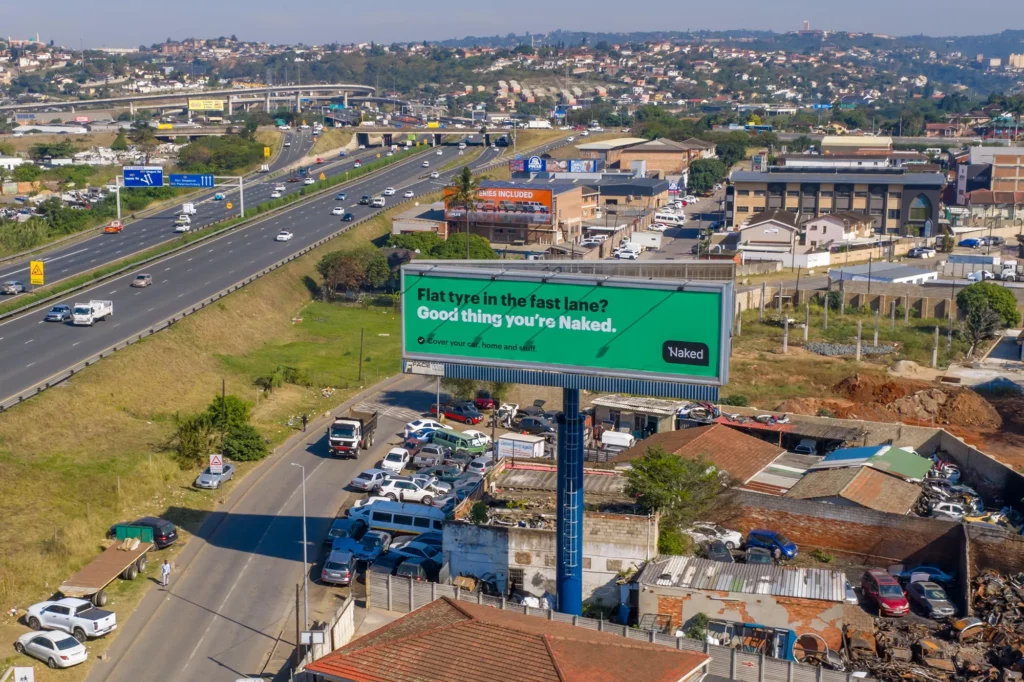
This massive 24-hour illuminated Wall Sign offers high impact exposure to all inbound traffic along the busiest and most important highway into the City. “In addition to the other Mega Sky Signs in our CBD premier holding, we are now able to offer advertisers even more engaging and unsurpassed brand awareness by dominating the skyline”, says Stevan Wilken, Face First Media’s Managing Director. “We are excited to have signed this 330 square meter site and remain focussed on our strategy of offering bold and pioneering opportunities with a noticeable power and influence in the Out of Home Space”.

While there is a tendency for media owners in a low-growth economic environment to consolidate and pause their development programme, Stevan points out that “Out of Home Media remains a solid and proven media format for geographical targeting that can engage a particular audience in a more effective manner than on-line media potentially can”. “We have therefore remained strategic in acquiring high-impact sites such as this Entrance Wall Sign in the Durban CBD. During the lock-down we also introduced a trio of LED Digital Super Signs on all incoming highways into Durban to lead the way in offering full digital coverage on the N3, N2 and M4”, Mr. Wilken explains.

At almost four times the size of a Super Sign and directly angled to the main traffic flows, this exceptional Mega Wall Sign offers unmatched brand visibility along the most receptive stretch of the N3 highway where vast volumes of traffic is slowing down and are being channelled into one of the busiest zones of the Inner City where taxi’s, busses and the trains cross-offer. “We are excited to offer this extraordinary site as we prepare for a rebound of the South African economy and gear ourselves for an increased demand for high impact Out-of-Home sites. We see this site as a springboard for brands to not only stand-out but re-engage their audiences with eye-catching content for deep-seated message receptibility”, Stevan concludes.

Statement by: Face First Media 1 April 2021

For any more information or a quote please contact us on  033 413-2439 or email us at info@facefirstmedia.co.za

The COVID-19 pandemic has dramatically changed consumer behaviour with more people working from home and staying indoors.

The coronavirus pandemic had a severe impact on the global out-of-home (OOH) market in 2020 and with renewed lockdowns worldwide in early 2021 the understanding of behavioural changes and consumer expectations will be key.

Lessons From 2020

With the OOH market being one of the hardest-hit media by COVID-19, a lot of lessons were learnt. Advertisers were forced to re-evaluate the way they think regarding how audiences are reached and engaged. It has also reminded advertisers to be prepared for the unexpected and to never stop adapting as many unexpected events can still occur.

Covid-19 has fundamentally changed both business and consumer behaviour which means advertisers will need to make changes to their products and services as well as their messaging. Remaining close to consumers and staying in touch is essential. The pandemic has also reiterated the importance for brands of striking the right tone with consumers.

Changing Consumer Behaviour

With people adapting to new normal consumer behaviour is rapidly evolving and this may continue as different facets of the pandemic plays out. Consumer behaviour typically evolves over years but with the pandemic, it only took a few weeks for massive changes to take place.

A change in consumer behaviour means the way companies reach their audiences change. Brands need to reconnect to audiences they have lost and need to find innovative ways of reaching new audiences by identifying how these audiences’ needs have changed.

The pandemic has changed when and how consumers shop and the amount of time they spent outdoors but also their sentiment as they respond to the crisis and try to adapt to the new normal. Consumers’ loyalty to certain brands have changed and they may place more emphasis on value or convenience and availability.

Opportunities and Challenges In 2021

OOH is expected to still play a very prominent role in terms of public information and informative messaging as the pandemic continues. Understanding and keeping abreast with behavioural change is key and keeping up with new trends.

The continued digitization of OOH and new technological capabilities means OOH will stay a preferred medium which enables advertisers to change and tailor messages in real-time. 2020 has seen a boom in creativity due to the pandemic and lockdowns worldwide and it is expected that this will continue into 2021.

The COVID-19 pandemic has had a huge influence on out-of-home advertising (OOH) because of curfews, quarantines, and lockdowns in many countries worldwide.

Lockdowns across the world led to an immediate drop in advertising spend as people are confined to the indoors and are requested to stay away from public places. This will continue to have an effect in 2021 but with vaccines being rolled out worldwide it is expected that consumer behaviour and advertising spend will gradually begin changing.

OOH Post Pandemic

The COVID-19 pandemic has resulted in people thinking about everyday things they miss and took for granted. These are the things people cannot wait to have back after the coronavirus and includes getting outside as much as possible. COVID-19-related restrictions have led to less interaction with others and people are eager to regain these experiences and to get back outside.

This means OOH will almost be more relevant than ever before. New studies have shown that when people have the opportunity to be outside, they are noticing billboards and other OOH media more than before the pandemic as there is an increased appreciation for outdoor surroundings and people are also more aware of their surroundings.

OOH’s Changing Role

With OOH being more relevant than ever before, it can also do so much more for brands and advertisers. OOH is becoming smarter with new technological advances and more adaptable. this is fuelled by creativity and innovation and by delivering purpose-driven content.

OOH advertising is integrating more and more with mobile, digital channels, social media, radio, and television and helping to fuel the growth of these mediums. There has been an increase in omnichannel campaigns to reach multiple audiences for greater synergies but also to target the same audience across different channels for improved customer awareness and experience.

Adapting to A New Reality

Covid-19 has fundamentally changed both business and consumer behaviour which means advertisers will need to make changes to their products and services as well as their messaging. This new insight into audiences’ wants and needs means more personalisation than ever before.

Consumer behaviour will become more complex and more difficult to analyse and advertisers will have to carefully re-evaluate their media strategies and messaging. Brands need to stay relevant by adapting and earning their audience’s trust. Storytelling will remain one of the biggest trends for 2021 where creative and dynamic content is used to improve engagement and connect with audiences.